Most transformation programs do not fail because the software is wrong.
They fail because the people funding and sponsoring the work do not get a clear enough view of what is actually happening until the problems are expensive, political, and hard to reverse.
That sounds obvious. It is not. In most large programs, executive reporting is built to reassure. It is designed to compress complexity, reduce noise, and create the appearance of control. By the time a steering committee pack reaches senior leaders, the difficult parts have often been softened into status colours, milestone percentages, and a short list of “known risks” that tell only part of the story.
I have seen programs that looked stable in the deck and unstable in real life. I have seen workstreams reporting green while key decisions were unresolved, data quality was deteriorating, and business teams were quietly losing confidence. I have seen sponsors receive updates that were technically true and operationally misleading at the same time.
That is the gap executive sponsors need to close.
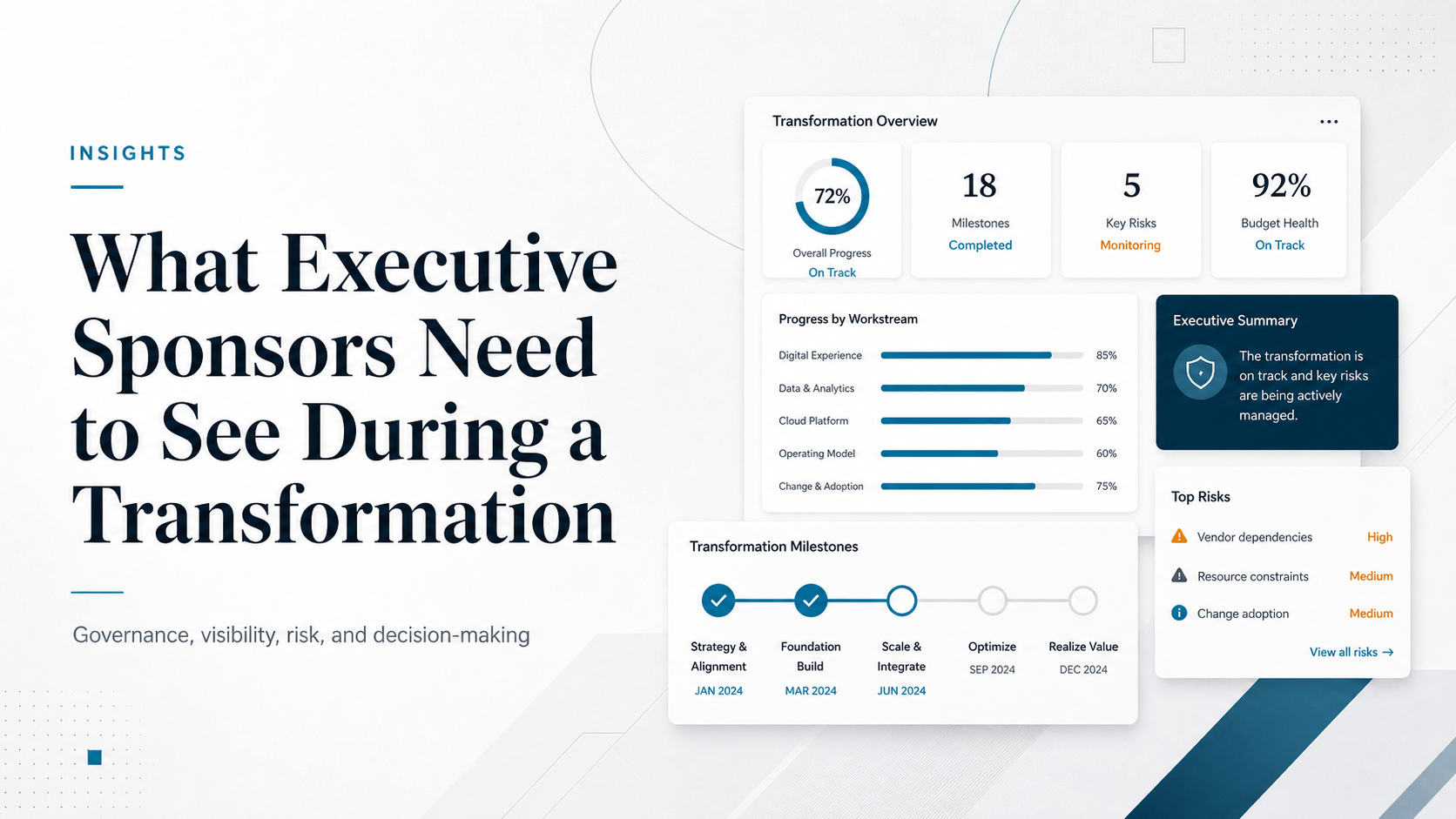
A transformation sponsor does not need to know everything. They do need to see the few things that tell them whether the program is truly under control, whether the business is aligned, and whether the promised outcome still has a real path to delivery.
That requires better visibility, not more reporting.
The purpose of executive visibility
An executive sponsor is not there to manage the daily program. They are there to create the conditions for success: clear decisions, organizational backing, timely escalation, commercial discipline, and sustained accountability across teams.
To do that properly, they need reporting that answers a more useful set of questions.
Are we solving the right problem?
Is the program still configured to deliver the outcome we approved?
Where is momentum strong, and where is it artificial?
What is slipping beneath the surface?
What decisions are late?
Where is ownership weak?
What is going to become a major issue in the next six to eight weeks if we do not intervene now?
That last question matters most. Strong executive oversight is not about reading out the present. It is about seeing around corners early enough to act.
What sponsors are usually shown instead
Most executive packs follow a familiar pattern. Overall RAG status. Budget consumed. Timeline summary. Top risks. Decisions required. Sometimes a milestone view. Sometimes a workstream summary. Usually too much text. Often not enough truth.
The problem is not that these elements are wrong. The problem is that they are usually presented without enough interpretation, without enough linkage between cause and effect, and without enough willingness to say what the team is genuinely worried about.
A program can appear green and still be heading toward trouble.
For example, timeline can look healthy because dates have not officially moved yet, even though upstream inputs are late and teams are already burning contingency. Budget can look stable because spend is tracking plan, while productivity is weak and rework is rising. Risks can look manageable because they are logged, discussed, and colour-coded, even though nobody has actually changed the conditions causing them.
This is where executive reporting becomes theatre instead of governance.
What Sponsors Actually Want to See
There are six areas that matter more than most dashboards suggest.
1. Decision Health
Every large transformation is a chain of decisions. Scope decisions. Design decisions. Data decisions. Operating model decisions. Resourcing decisions. Vendor decisions. Policy decisions. If those decisions are late, unclear, revisited repeatedly, or made without the right owners in the room, the program will slow down long before it formally slips.
Sponsors need to see the real decision backlog. Not just “decisions required this month,” but the health of the decision-making system itself.
- How many critical decisions are overdue?
- How long are decisions taking?
- Which workstreams are waiting?
- What is being built or planned on assumptions because a decision has not been made?
- Which decisions, if unresolved, will affect testing, build, data migration, training, or deployment?
If decision velocity is weak, the program is weaker than it looks.
- Cross-team dependency pressure
The hardest part of transformation is rarely the work inside one team. It is the work between teams.
Programs break down in the gaps between business leads and technical leads, between implementation partners and client teams, between design and data, between testing and cutover, between what one workstream assumes and what another can actually deliver.
Executive sponsors need a clear view of dependencies that are becoming critical. Not a long spreadsheet of linked tasks. A serious view of where the program is vulnerable because one team’s progress depends on another team’s unresolved issue, delayed output, or weak capacity.
A sponsor should be able to ask, at any point: where are we carrying integration risk between teams, and what is being done about it?
If dependency management is weak, the program is operating on optimism.
- Data readiness
This is one of the most under-reported areas in transformation programs, especially early on.
Data issues are often treated as a technical track until late in the program, when they suddenly become business issues, testing issues, reporting issues, go-live issues, and credibility issues all at once.
Sponsors need to see data readiness as a business indicator, not just a migration status line.
What is the actual condition of source data?
Where is cleansing behind?
Who owns remediation?
Are mapping decisions stable?
Are business units engaging at the level required?
What defects are repeating across mock cycles?
How much of the downstream risk profile is really a data problem in disguise?
If data readiness is weak, confidence in timeline should be discounted accordingly.
- Business adoption reality
Many programs report on change management as if communications sent and training materials produced are proof of adoption readiness. They are not.
Executive sponsors need a more honest read on whether the business is truly preparing to absorb the change.
Are leaders engaged, or merely present?
Do business users understand what is changing for them?
Are process owners actively shaping the future state, or are they reviewing documents too late?
Is there resistance in specific areas?
Are local teams underestimating the amount of operational disruption ahead?
Is the organization making time for design, testing, training, and deployment, or treating program participation as extra work around the margins?
A transformation does not become real when the system is configured. It becomes real when the business starts to behave differently.
Sponsors need to see whether that shift is happening.
- Testing quality, not just testing progress
A common mistake in executive reporting is to focus on test execution numbers without enough attention to what those numbers mean.
Test cases executed is not the point. Defect closure counts are not the point. Even pass rates can be misleading without context.
Sponsors need visibility into testing quality.
Are we testing the right scenarios?
Are the defects clustered around one area?
Are they pointing to configuration weakness, data weakness, environment instability, unclear requirements, or process design issues?
Are business teams meaningfully participating, or is testing being pushed through to preserve schedule optics?
Are we learning what we need to learn before the next phase, or just producing activity?
A program that is “getting through testing” is not necessarily building confidence. Sometimes it is only accelerating uncertainty.
- Delivery confidence by workstream
Executive sponsors should never have to rely only on a single overall program status. They need a view by workstream that goes beyond colour and allows them to understand where confidence is earned and where it is thin.
A useful workstream view does not simply ask whether the plan is on track. It asks whether the team has what it needs to deliver, whether outputs are landing on time and at the right quality, whether risks are increasing or decreasing, whether leadership is strong, and whether stakeholders trust what they are hearing.
Some workstreams move slower than others for valid reasons. Some appear calm because they have not yet reached the point of stress. Sponsors need the maturity to distinguish between temporary quiet and real control.
What good executive reporting looks like
Good executive reporting is disciplined, interpretable, and hard to manipulate.
It is disciplined because it focuses on the few indicators that genuinely matter.
It is interpretable because cause and effect are visible. Leaders can see what is driving a risk, where it sits, who owns it, and what happens next if nothing changes.
It is hard to manipulate because it is built from evidence, not comfort. It does not hide behind vague labels like “work in progress” or “monitoring closely” when the real message is that ownership is unclear or a deadline is unlikely to hold.
A strong executive pack usually has five qualities.
First, it distinguishes activity from progress. A lot can be happening without the program becoming safer.
Second, it shows trend, not only point-in-time status. Sponsors need to know whether a workstream is stabilizing or degrading.
Third, it links issues across domains. A delayed design decision may become a testing issue, a training issue, and a cutover risk later. Good reporting makes those connections visible.
Fourth, it separates controllable problems from structural ones. Some issues can be managed within the team. Others require sponsor intervention because they involve funding, authority, prioritization, vendor challenge, or business accountability.
Fifth, it says plainly when confidence is low. Mature governance does not punish honesty. It depends on it.
The warning signs sponsors should take seriously
There are a few patterns that deserve immediate executive attention, even when the broader program still looks acceptable.
One is recurring ambiguity. If the same issue keeps returning in different language, it usually means the underlying problem has not been solved.
Another is last-minute recovery language. When teams repeatedly say they will “make up time in the next phase,” “re-sequence,” or “close the gap during testing,” sponsors should look closely at whether the recovery logic is real or rhetorical.
Another is false consensus. If meetings sound aligned but decisions keep reopening, responsibilities stay blurred, or downstream teams keep asking the same questions, alignment is weaker than it appears.
Another is shallow risk ownership. A risk without a credible action path is not managed. It is merely documented.
And then there is the most dangerous pattern of all: when teams stop escalating because they believe nothing meaningful will happen when they do. At that point, the governance model is no longer functioning as intended. The program may still be moving, but executive oversight is working on delayed information.
How sponsors should use the information they receive
The best sponsors do not react to every issue. They intervene selectively, visibly, and early enough to matter.
That means using reporting to ask better questions, not to perform authority.
- What exactly is driving this risk?
- When did we first know it?
- What has changed in the last month?
- Who is accountable for resolution?
- What support or decision has been missing?
- What would a realistic recovery plan require?
- What trade-off are we avoiding naming?
These are not hostile questions. They are clarifying ones. In a healthy program, they improve delivery because they force precision.
Sponsors also need the discipline to protect the signal. If every committee becomes a deep dive into detail, teams will either drown leaders in information or sanitize updates to survive the forum. Neither helps.
The goal is not executive immersion in delivery. It is executive visibility into the right pressure points.
The sponsor’s real job
At the senior level, transformation success depends less on enthusiasm and more on institutional seriousness.
That means clear decisions. Clear accountability. Clear escalation. Clear trade-offs. Clear recognition that a transformation is not just a project to be monitored, but a coordinated change effort that will expose weaknesses in structure, ownership, process, and leadership.
Executive sponsors are uniquely placed to deal with those issues because they sit above the silos that slow everyone else down.
But they can only do that if they can see what matters.
Not the polished version.
Not the committee version.
Not the version designed to keep the meeting moving.
The real version.
Where the program is strong.
Where it is fragile.
Where confidence is earned.
Where it is borrowed.
Where intervention is needed now, not later.
That is what executive sponsors need to see during a transformation.
Because by the time the whole truth appears in the timeline, the budget, or the go-live plan, it is usually much more expensive to fix.